Creating a Sanctuary for Quiet Reading at Home
Table of Contents
- Creating a Sanctuary for Quiet Reading: Where to Start
- Cozy Reading Nook Ideas That Actually Work
- The Best Lighting for Reading Rooms
- Acoustic Treatment: The Quiet Part Everyone Skips
- Ergonomic Seating and Layout Design for Long Reading Sessions
- Books That Help You Slow Down
- Making It Yours on a Budget
- Frequently Asked Questions
Last Updated: September 16, 2026
Creating a Sanctuary for Quiet Reading: Where to Start
Creating a sanctuary for quiet reading starts with one decision: treating a corner of your home as a place with a purpose, not just leftover space. This guide from Nova Basi walks through the practical steps, from picking the spot to softening the sound around it.
Choosing the Right Spot in Your Home
The best reading spot is the one you will actually walk to at the end of a long day. That usually means a low-traffic corner, away from the kitchen, the front door, and any screen that stays on.
Look for three things:
- A wall you can put your back against
- At least one window within a few feet
- Distance from the loudest room in the house
Setting Boundaries That Protect Your Quiet Time
Quiet reading only survives if the people around you know when it happens. Pick a window, even thirty minutes, and treat it like a standing appointment.
A few boundaries that hold up in practice:
- Tell your household the time, not just the intention
- Put your phone in another room, not face-down beside you
- Keep a single book on the side table so there is no choosing involved
Cozy Reading Nook Ideas That Actually Work
A cozy reading nook is a small, defined area built around one chair, one light, and one surface for a cup. It does not need its own room, and it does not need to be expensive.
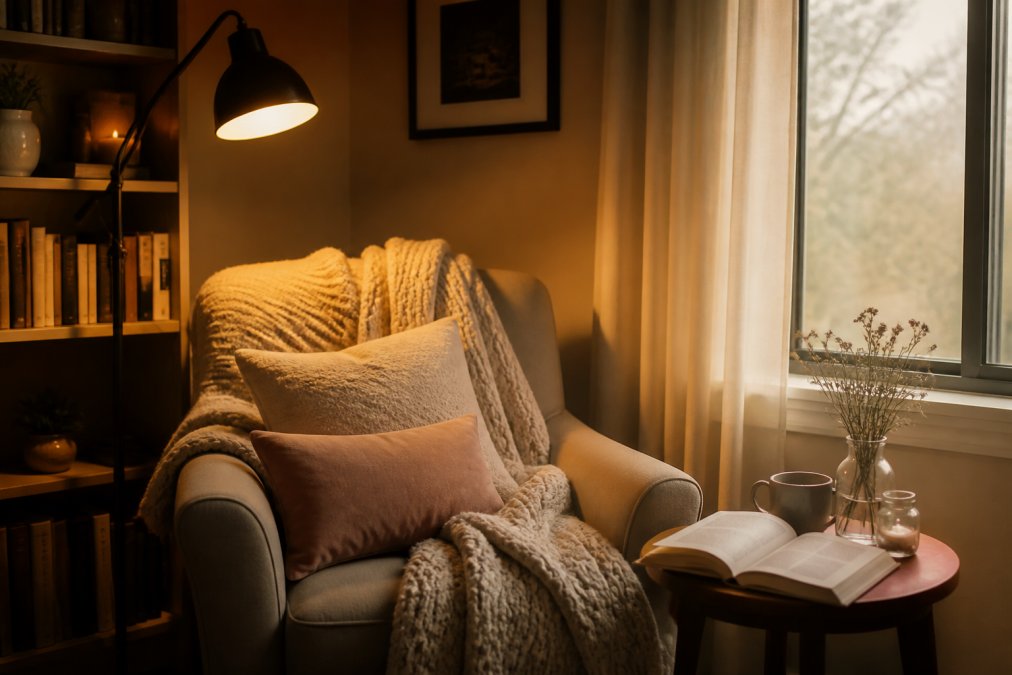
Soft Textures, Cushioned Chairs, and Throw Pillows
Soft textures do real work in a reading nook. They absorb sound, they warm a hard floor, and they give your body somewhere to land after a demanding day.
The Best Lighting for Reading Rooms
The best lighting for reading rooms combines soft ambient light with a focused task light positioned beside your shoulder, never directly in front of your face. Get this wrong and eye strain ends the session before the chapter does.
Here is how the two layers differ:
| Layer | Purpose | Typical Placement |
|---|---|---|
| Ambient | Fills the room, reduces contrast | Ceiling fixture or wall sconce |
| Task | Lights the page directly | Floor lamp or clip-on, shoulder height |
| Accent | Sets the mood, adds warmth | Small table lamp or candle |
The Numbers That Actually Matter
Most guides stop at "use a warm bulb." The specifics are what keep you reading past chapter three.
- Color temperature: Look for 2700K to 3000K on the bulb packaging. That range reads as warm white. Anything at 4000K or above (often labeled "cool white" or "daylight") pushes toward blue and feels clinical on the page.
- Brightness: A task lamp in the 450 to 800 lumen range is enough for a paperback at arm's length. Higher output creates glare off glossy pages; lower output forces you to squint.
- Placement height: Set the lamp shade so the bottom edge sits at roughly shoulder height when you are seated, and position it to the side of your dominant hand so the light crosses the page without casting your own shadow onto it.
- Distance: Keep the task light within about 18 to 24 inches of the book. Beyond that, the light spreads and you lose the focused pool that makes reading easy.
Natural Light vs. Ambient and Task Lighting
Natural light is the best light for reading during the day, provided it does not fall directly on the page. Direct sun creates glare, and glare is what actually tires your eyes.
A Quick Test Before You Commit
Sit in the chair with a book at the time of day you actually plan to read. If you can see the page without leaning forward, and you cannot see the bulb's reflection on the paper, the setup is right. If you find yourself tilting the book toward the light, move the lamp closer or raise it a few inches.
Acoustic Treatment: The Quiet Part Everyone Skips
Sound is the part of a reading sanctuary that most advice ignores entirely. You can own the perfect chair and still abandon it because the room carries noise from a television two walls away.
- Hang a fabric curtain over a hard wall or doorway
- Add a rug and an upholstered chair to break up reflections
- Place a bookshelf against the shared wall to block sound
- Close the door, or add a draft stopper if there is a gap underneath
Ergonomic Seating and Layout Design for Long Reading Sessions
Ergonomic seating for reading looks different from office ergonomics. You are not typing, so the goal is supported stillness rather than movement.
Three adjustments matter most:
- Feet flat on the floor, or on a small stool
- The book held at roughly chest height, not in your lap
- Elbows supported, so your arms are not holding the book's weight
Books That Help You Slow Down
Books that help you slow down tend to be shorter, quieter, and more sensory than plot-driven bestsellers. They reward attention instead of demanding momentum.
Making It Yours on a Budget
A reading sanctuary does not require new furniture, a spare room, or a landlord's permission. Most of what you need is already somewhere in the house, and the rest can be handled without drilling a single hole.
The No-Damage Rule for Renters
If you rent, treat every upgrade as reversible. That single constraint changes what you buy and how you install it.
- Adhesive hooks rated for 3 to 5 pounds hold a lightweight curtain rod, a small wall sconce, or a framed print without leaving marks when removed.
- Tension rods fit inside a window frame or doorway and hold a blackout or fabric curtain with zero hardware.
- Command strips and removable mounting putty handle lightweight art and small shelves. Skip anything that needs a stud finder.
- Freestanding screens or a tall bookshelf can carve out a corner without touching the walls, and they double as sound blockers.
Work Through This Before Spending Anything
- Move an existing armchair to a low-traffic corner
- Repurpose a side table as a book and mug surface
- Bring a floor lamp from another room
- Layer a spare blanket and two pillows onto the chair
- Add a rug if the floor is bare
- Hang a curtain or throw over the hardest wall
Small-Apartment Moves That Do Not Cost a Room
When you do not have a spare corner, you borrow one.
- The closet conversion: A walk-in or reach-in closet with the door removed becomes a reading nook in about an hour. Add a cushion, a clip-on light, and a small stool, and you have a space that closes off visually from the rest of the apartment.
- The bed-as-chair: If floor space is tight, a firm wedge pillow against the headboard turns your bed into a supported reading position without a second piece of furniture.
- The under-window strip: A 30-inch-deep stretch of wall under a window fits a narrow bench or a floor cushion and a small side table. It reads as intentional once a rug defines the footprint.
- The balcony or fire escape (where allowed): A folding chair, a small tray table, and a battery-powered clip light create an outdoor reading spot that packs away in seconds. Check your lease before using shared outdoor space.
What to Buy First
When you do buy, buy one thing at a time. A copper candle or a glossy mug for your evening tea costs very little and signals that the space is finished, which is often what makes you return to it.


The cheapest sanctuary is a chair you already own, moved to a corner you already have, lit by a lamp you already bought. Ritual comes from repetition, not from spending, and no upgrade is worth a security deposit.
Frequently Asked Questions
What are the essential elements of a quiet reading space?
A quiet reading space needs four things working together: comfortable ergonomic seating, layered lighting you can adjust, some form of sound dampening, and a way to store books within arm's reach. Soft textures like throw pillows and blankets help the room feel calmer. The most overlooked element is acoustic treatment. A rug, curtains, or a bookshelf against a shared wall absorbs noise and makes the space feel genuinely quiet, not just visually peaceful.
How can lighting affect the atmosphere of a reading nook?
Lighting does more for a reading nook than any piece of furniture. A floor lamp with a warm bulb placed behind your shoulder reduces eye strain and creates a pool of light that signals to your brain it is time to slow down. Avoid overhead lights that flatten the room. Layer ambient lighting with a small task light so you can adjust brightness as daylight fades. Natural light works well during the day, but direct sun on the page causes glare.
How do I minimize distractions in my home reading space?
Start by removing screens from the room entirely. A digital-free zone works because your brain learns that this chair, this lamp, this corner means reading, not scrolling. Put your phone in another room or in a drawer. If noise from your household or street is unavoidable, a white noise machine or a felt panel behind your chair can help. Even a closed door changes how your brain registers the space.
Can I create a reading sanctuary on a tight budget?
Yes. The highest-impact changes cost the least. Move an existing armchair to an unused corner near a window. Add a secondhand floor lamp with a warm LED bulb. Layer a blanket and two pillows you already own. A thrifted rug on a hard floor reduces echo and adds softness. Books stacked on a small side table work as well as a shelving unit. The goal is comfort and quiet, not matching furniture.
Building a sanctuary for quiet reading is less about decorating and more about protecting a small window of your day from everything that competes for it. Nova Basi exists for that window: quiet novellas, journals, and keepsakes designed to help you slow down and carry the feeling of a story into the rest of your evening. Explore the collection, choose one story, and give yourself thirty minutes with it tonight.