Finding Peace in Daily Routines: A Simple Guide
Table of Contents
- Why Peace Gets Lost in a Busy Day
- How to Build a Peaceful Daily Routine That Fits Real Life
- A Morning Routine for Mindfulness in Ten Minutes or Less
- Practicing Mindfulness in Daily Life Without Adding a Task
- An Evening Routine for Relaxation and Letting Go
- Short Practices for Busy or Unpredictable Days
- Personalizing Your Routine and Troubleshooting What Blocks It
- How to Measure Progress Without Chasing Constant Calm
- Frequently Asked Questions
Last Updated: October 12, 2026
Why Peace Gets Lost in a Busy Day
Finding peace in daily routines rarely fails from lack of willpower.
The pattern is predictable: the alarm goes off, your hand reaches for a screen, and email, news, and messages arrive before your feet hit the floor.
Peace does not disappear in one dramatic moment.
Peace is not something you find once. It is something you rebuild, in small pieces, inside the routine you already have.
How to Build a Peaceful Daily Routine That Fits Real Life
A peaceful daily routine is a set of small, repeatable practices tied to moments you already have, not a separate schedule bolted onto your day.
Most advice asks you to add an hour of meditation before sunrise; that plan collapses by Wednesday. Instead, attach calm to transitions you already make.
- Waking up
- Leaving for work or starting work
- Finishing work
Each transition is a doorway. Walk through it slowly, and the whole day changes shape.
Start With the Transitions, Not the Whole Day
Pick one transition and give it sixty seconds of attention. That is the entire starting point.
A common mistake is redesigning the whole day at once. People build an elaborate morning plan, fail on day three, and quit. One transition, done daily, beats a full overhaul that lasts a week.
A Morning Routine for Mindfulness in Ten Minutes or Less
A morning routine for mindfulness does not need to be long or perfect. Ten minutes is enough to set the tone, and most of it can happen before you touch your phone, one stretch of unstimulated time before the day's demands arrive.
Here is a ten-minute sequence that fits an ordinary weekday:
- Sit up and take five slow breaths before leaving the bed (1 minute)
- Drink a glass of water without a screen in front of you (2 minutes)
- Do a short body scan, noticing your feet, hands, and jaw (3 minutes)
- Name one thing you are looking forward to today (1 minute)
- Read one page of something quiet (3 minutes)
That last step matters more than it sounds: a few pages of a slow, emotionally rich story give your mind somewhere gentle to land.
Why Ten Minutes Works Better Than Sixty
People who try a sixty-minute morning practice often quit within two weeks, while those who start with ten minutes are still going a month later.
If ten minutes feels like too much, cut it to three. Three minutes of slow breathing before you check your phone is a real practice, not a lesser version of a longer one. A short practice you actually do beats a long one you skip.
Paced Breathing Before You Check Your Phone
Paced breathing is the fastest way to settle your nervous system, and it takes under two minutes: inhale for four, hold for four, exhale for six, repeat ten times.
The longer exhale is the active ingredient: a slow, extended exhale is associated with activation of the parasympathetic branch of the nervous system, the part responsible for rest and recovery.
Do this before you open email, and you will respond to your inbox instead of reacting to it. If you only adopt one thing from this section, adopt this one.
A Realistic Morning-to-Evening Frame
A morning routine is only as good as the day it opens into.
You do not need all three on day one. Start with the morning anchor for two weeks, then add a midday reset, even sixty seconds of slow breathing between meetings counts.
This is the difference between a routine that survives a busy week and one that collapses when your schedule changes.
Practicing Mindfulness in Daily Life Without Adding a Task
Mindfulness in daily life works best when it rides along with something you already do. You do not need a cushion, an app, or a quiet room.
Pick one daily activity and give it your full attention:
- Washing dishes: feel the water temperature and the weight of each plate
- Walking to your car: notice the air, the ground, the sounds around you
- Drinking tea or coffee: taste the first sip instead of drinking on autopilot
None of these take extra time. Mindfulness is not a task but a quality of attention you bring to tasks you already have.
An Evening Routine for Relaxation and Letting Go
An evening routine for relaxation is less about doing and more about stopping, telling your body the day is over well before your head hits the pillow.
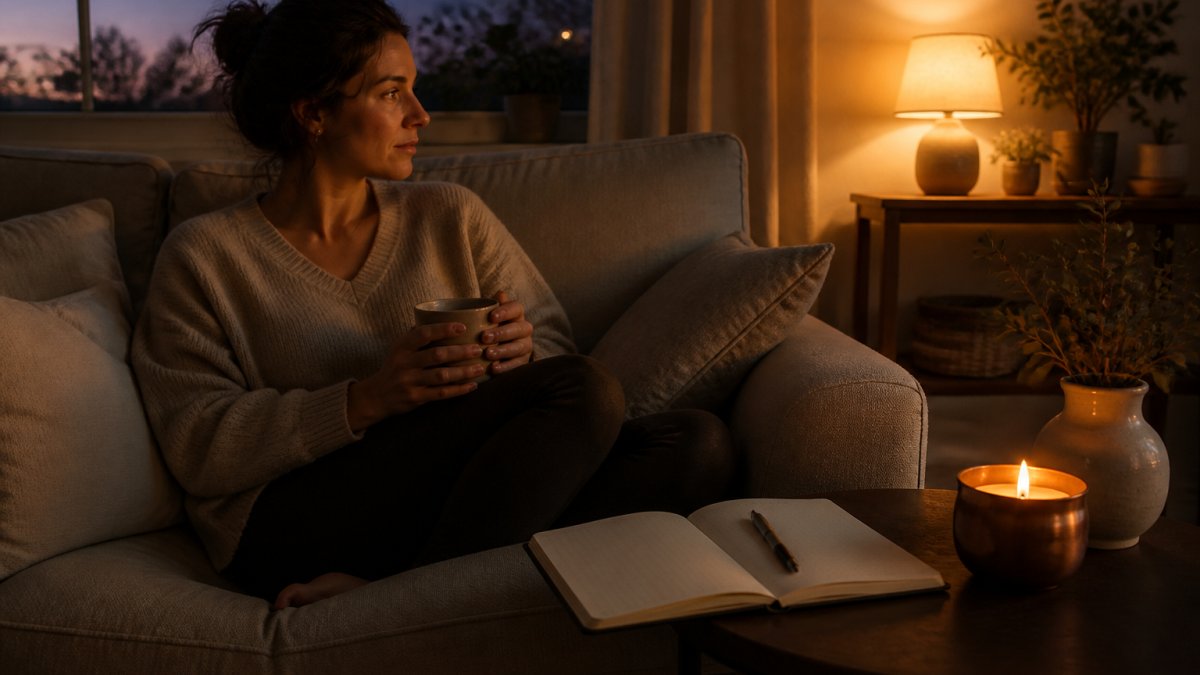
Close the day on purpose: write down tomorrow's three most important tasks so your mind stops rehearsing them, then dim the lights and step away from screens for the last thirty minutes.
A warm drink, a candle, and a few pages of a quiet book can be a comforting ritual for sleep. The ritual itself is the signal.
Journaling Prompts for Self-Reflection and Forgiveness
Journaling turns a restless mind into a page you can look at. Five minutes is enough.
Try these prompts:
- What felt heavy today, and what can I set down?
- Who do I need to forgive, including myself?
- What was one small moment of beauty today?
Answer one prompt, not all four. The goal is honesty, not volume. A dotted notebook kept by your bed makes this easier than opening a laptop.
Short Practices for Busy or Unpredictable Days
Some days will not allow a routine at all. On those days, use micro-practices instead. Each one takes under a minute and can be done anywhere.
- Three slow breaths before a meeting starts
- One minute of silence in the car before walking inside
- A single sentence of gratitude while waiting for coffee
A short practice still counts. Consistency matters more than duration: a sixty-second reset done daily beats a thirty-minute session you never get around to.
Personalizing Your Routine and Troubleshooting What Blocks It
The best routine is the one you will actually keep, so it has to fit your life rather than an ideal version of it. If a practice keeps failing, the practice is usually the problem, not you. Most advice presents one path, sit still, breathe, journal, and treats deviation as a lack of commitment, which is why so many people quit.
Match the Practice to Your Temperament
People differ in how they settle: some calm down by slowing the body, others by occupying it. Neither is better.
- If sitting still makes you restless, walk instead. A ten-minute walk without headphones is a legitimate mindfulness practice.
- If silence feels oppressive, use guided audio. A voice giving you something to follow can be more settling than your own thoughts.
- If journaling feels forced, try reading a page of something quiet, or simply naming three things you noticed today.
The form is flexible. The intention is not.
Troubleshooting the Common Blocks
| What Blocks You | Likely Cause | What to Try Instead |
|---|---|---|
| No time in the morning | Routine is too long | Cut it to three minutes |
| Forget to practice | No trigger attached | Link it to an existing habit, like pouring coffee |
| Mind wanders constantly | Expectation is too high | Shorten the session, not the effort |
| Falls apart on busy days | All-or-nothing thinking | Switch to a one-minute reset |
| Feels like a chore | Practice does not suit you | Swap it for one you enjoy |
| Works alone, fails around family | No shared expectation | Tell one person what you are doing and why |
That last row is the one most guides skip. A practice that works alone often collapses the moment another person enters the room, a partner, a child, a roommate, a phone call. This is not a personal failing but a boundary problem, and boundaries are part of the routine.
Peace Inside Relationships and Responsibilities
A daily routine does not exist in a vacuum; it runs alongside caregiving, work demands, shared space, and conflict. If it only works when no one else is around, it is not a routine but a retreat.
A few practical moves:
- Name the time. Tell the people you live with that you take ten minutes in the morning and ten at night. Most friction comes from the practice being invisible, not from the practice itself.
- Use transitions as boundaries. The walk from the car to the front door, the moment after closing a laptop, the first minute after a difficult call, these are natural edges where you can reset before the next demand.
- Lower the bar on hard days. On a day with a sick child or a deadline, a single slow breath before answering a tense message is the whole practice. It still counts.
If a practice keeps getting interrupted, do not abandon it, shrink it. A sixty-second version that survives a chaotic household beats a thirty-minute version that only works on quiet Sundays.
Measuring Progress Without Chasing Constant Calm
Peace is not a constant state, and treating it as one sets you up to fail. Everyone has hard days.
Track it loosely:
- How many days this week did you pause before checking your phone?
- How often did you notice tension in your body before it became a headache?
- Did you sleep better on the nights you kept your evening ritual?
A simple tally in a notebook is enough. If you want a place to keep it, our spiral notebook has 140 dotted pages and a soft-touch cover, made for exactly this kind of daily tracking.

What matters is direction, not perfection. A week with three calm mornings is a good week.
How to Measure Progress Without Chasing Constant Calm
Peace is not a constant state, and treating it as one sets you up to fail. Everyone has hard days.
Track it loosely:
- How many days this week did you pause before checking your phone?
- How often did you notice tension in your body before it became a headache?
- Did you sleep better on the nights you kept your evening ritual?
A simple tally in a notebook is enough. If you want a place to keep it, our spiral notebook has 140 dotted pages and a soft-touch cover, made for exactly this kind of daily tracking.
What matters is direction, not perfection. A week with three calm mornings is a good week.
Frequently Asked Questions
How can I find more calm in my daily routine when my schedule is unpredictable?
Anchor your practices to transitions rather than fixed clock times. A 60-second paced breathing pause before you open your laptop, a slow sip of tea before your first meeting, or three deep breaths in the car before you walk inside all work on days that refuse to follow a plan. The goal is a repeatable cue, not a perfect timetable. Keep one practice under two minutes so it survives the days when everything else falls apart.
What small habits can help me feel more peaceful during a busy day?
Small, low-effort habits tend to stick better than ambitious ones. Try a tech-free first ten minutes of the day, a mindful walk without your phone, or writing one sentence in a journal before bed. Reducing screen time and creating short tech-free zones at meals gives your attention a rest. None of these require an hour of silence; they require consistency. Stack a new habit onto something you already do, like breathing slowly while your coffee brews.
How do I know if my routine is actually working?
Look for shifts in how quickly you recover, not for a permanent state of calm. Notice whether you return to baseline after a stressful meeting faster than you did a month ago, whether you sleep through the night more often, or whether you catch yourself reacting less sharply. Peace is not a constant feeling; it is the gap between a trigger and your response. Track one or two signals in a notebook rather than rating every day.
What does inner peace mean in everyday terms?
Inner peace is less a mood than a relationship with your own experience. It shows up as self-compassion when you fall short, the ability to let go of a grudge instead of rehearsing it, and a sense of connection with your core values even on an ordinary Tuesday. It does not require a retreat or a perfect morning. It grows from small, repeated choices: how you speak to yourself, what you give your attention to, and how you close the day.
Building a peaceful daily routine is not about adding more to your day. It is about giving a few existing moments your full attention, and letting those moments carry you. Nova Basi exists for that reason: quiet novellas, curated journals, and small rituals designed to help you slow down and breathe more deeply. Explore our collection and find the keepsake that fits your evening. Explore Now