How to Create a Daily Ritual: A Gentle 2026 Guide
Table of Contents
- What a Daily Ritual Is (and How It Differs From a Routine)
- Morning Ritual Ideas for Mindfulness to Start Your Day
- How to Practice Slow Living Inside a Busy Schedule
- Daily Ritual Templates You Can Copy Tonight
- Ritual Stacking vs. Habit Stacking: Which One Sticks?
- When Your Ritual Falls Apart: A Troubleshooting Guide
- Simple Tools and Keepsakes That Support the Practice
- Conclusion: Begin Small, Return Often
- Frequently Asked Questions
Last Updated: September 22, 2026
What a Daily Ritual Is (and How It Differs From a Routine)
A daily ritual is a small set of actions you repeat with care and attention, not just speed. The difference comes down to intention. A routine gets you out the door. A ritual gives the moment meaning.
Think about your morning coffee. If you gulp it standing at the counter while checking email, that's a routine. If you sit by a window, hold the warm mug, and take three slow breaths before the first sip, that's a ritual. Same action. Different quality of attention.
Finishing a book is a task. Savoring one chapter with a candle lit is a ritual. That shift from doing to being is the whole point.
Many people find that intention setting is what separates a ritual that sticks from one that fades. You're not just repeating a behavior. You're marking a moment as yours.
Morning Ritual Ideas for Mindfulness to Start Your Day
The best morning ritual is short, sensory, and easy to repeat. Aim for five to ten minutes. Anything longer tends to collapse under a busy schedule.
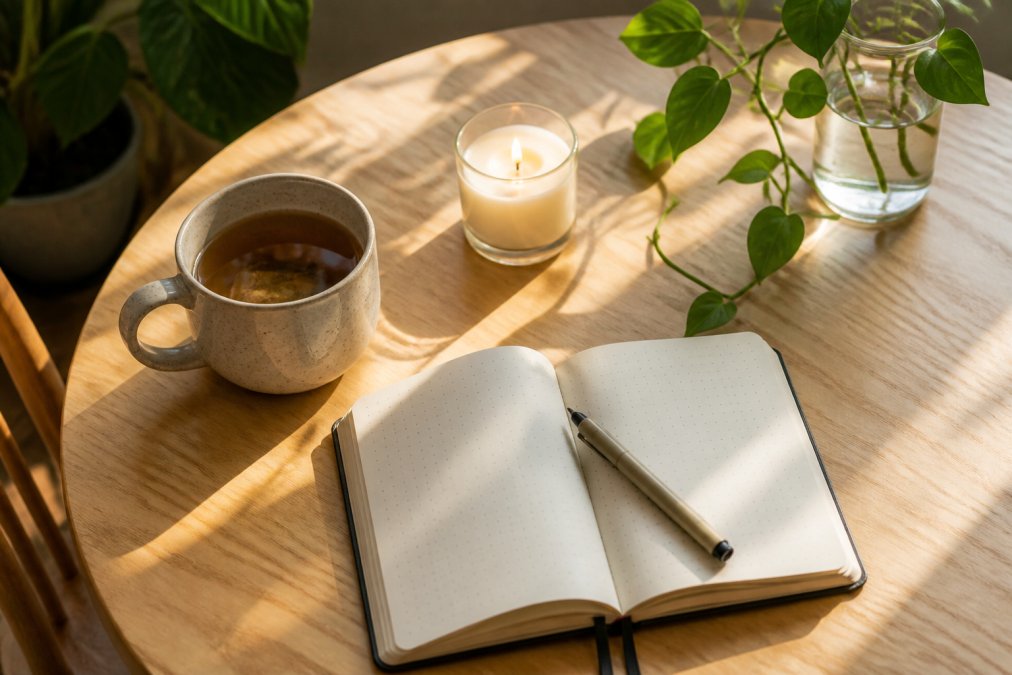
Try one of these to begin:
- Three breaths before your feet hit the floor. Notice the weight of your body.
- A warm drink held with both hands. No phone. Just the warmth.
- One page in a journal. Write a single sentence about how you feel.
- A short stretch by a window. Let natural light reach your eyes.
- A gratitude note. Name one small thing you're glad exists.
The goal isn't productivity. It's presence. A common mistake is turning the morning into a checklist. That kills the ritual fast.
How to Practice Slow Living Inside a Busy Schedule
Slow living isn't about having more time. It's about giving full attention to the time you already have. You can practice it in the gaps.
Here's the honest part most guides skip: you will not find a spare hour. You have to claim minutes. A two-minute pause between meetings counts. So does eating lunch without a screen.
A few ways to practice slow living without quitting your job:
- Pick one daily anchor. Coffee, a walk, or a bath. Protect it.
- Do one thing at a time. Multitasking scatters your attention.
- Add a sensory cue. A scent, a texture, a favorite mug.
- Leave white space. Don't fill every gap with a task.
The American Psychological Association's stress resources note that brief, regular moments of calm can help with stress reduction over time. Small and often beats big and rare.
Daily Ritual Templates You Can Copy Tonight
Here are three templates you can use as-is. Adjust the timing to fit your day.
| Template | Time Needed | Best Time | Core Actions |
|---|---|---|---|
| The Three-Minute Reset | 3 minutes | Midday | Three breaths, one stretch, one sentence written |
| The Evening Wind-Down | 15 minutes | Before bed | Dim lights, warm drink, read one chapter |
| The Morning Anchor | 8 minutes | After waking | Light, warm drink, journal page, no phone |
Pick one. Run it for a week. Then adjust.
A daily ritual template works best when it's almost boring. If it's too elaborate, you'll skip it on hard days. Simple survives.
Ritual Stacking vs. Habit Stacking: Which One Sticks?
Habit stacking and ritual stacking both borrow an existing behavior as a cue, but they aim at different outcomes. Habit stacking is about automaticity, getting a behavior to run without conscious decision. Ritual stacking is about meaning, attaching an emotional or sensory signature to a moment so you want to return to it.
The mechanic is the same in both cases. You pick an anchor you already do reliably (pour coffee, brush teeth, close the laptop), then attach the new behavior immediately after. What changes is the payload.
- Habit stacking: "After I brush my teeth, I floss." The goal is repetition until the behavior feels automatic.
- Ritual stacking: "After I light my evening candle, I read one page." The goal is atmosphere, the candle becomes the doorway into the moment.
A common pattern among people who keep a ritual for years is that they use habit stacking for the skeleton and ritual stacking for the skin. The habit gets them to the chair. The ritual makes the chair somewhere they want to sit.
Here's a concrete sequence you can test this week:
- Anchor: You already pour a morning coffee. That's your cue.
- Habit layer: Before the first sip, you write one sentence in a notebook. Functional, repeatable, low effort.
- Ritual layer: You use the same mug, sit in the same chair, and let the steam hit your face before you write. Now the moment has a sensory signature.
If you strip the ritual layer, the habit still runs, but it tends to feel like a chore within a few weeks. If you strip the habit layer, the ritual has no reliable trigger and drifts. The blend is what survives a busy Tuesday.
One trade-off worth naming: ritual stacking takes slightly more setup than habit stacking, because you have to choose a cue that actually means something to you. A candle you don't like the smell of is worse than no candle.
Many people find that rituals tied to a sensory cue, like a scent or a specific mug, outlast bare habits because the cue does the remembering for them. The behavior gets repeated, and the meaning keeps you coming back.
When Your Ritual Falls Apart: A Troubleshooting Guide
Rituals break. That's normal. The fix isn't discipline. It's a smaller version of the same ritual.
Here's how to handle the most common problems:
- You keep skipping it. Shrink it. If ten minutes fails, try two.
- It feels like a chore. Add a sensory element you actually enjoy.
- You forgot for a week. Restart tonight. No guilt, no restart ceremony.
- Life got chaotic. Keep one anchor. Drop the rest for now.
- It stopped feeling special. Change one detail. A new scent or spot.
Simple Tools and Keepsakes That Support the Practice
Most guides on daily rituals quietly assume you'll buy something, a candle, a journal, a matching set. You don't have to. A ritual needs a cue, not a receipt. The object matters far less than what you attach to it, and a zero-cost cue works just as well as a $40 one.
Start with what's already in your home:
- A mug you already own. Pick one and use only that one for your ritual. The repetition is what turns it into a cue.
- A plain notebook or the back of an envelope. One sentence a day is enough. Dotted pages are nice, not necessary.
- A library book. Borrowing a book for an evening wind-down costs nothing and gives the ritual a natural end point, you return it, you pick a new one.
- A tea light or a plain candle. A single tea light can signal "the day is closing" just as clearly as a scented jar.
- A chair, a window, a specific corner. Place is a cue too, and it's free.
Conclusion: Begin Small, Return Often
The hardest part of a daily ritual isn't starting. It's returning after you've stopped. Life will interrupt you. Meetings will run late. Some weeks you'll forget entirely.
Frequently Asked Questions
How do I create my own daily ritual?
Start by naming the feeling you want to carry into your day, such as calm or clarity. Choose one small action that takes under five minutes, like lighting a candle or writing three lines in a journal. Anchor it to something you already do, like your first cup of coffee. Repeat it at the same time for two weeks. A daily ritual grows from consistency, not from size.
What are simple examples of daily rituals?
Simple daily rituals include drinking your morning coffee without your phone, writing one sentence of gratitude each night, stepping outside for five slow breaths before work, or reading a few pages of a novella before bed. Each one takes minutes, but the repetition is what turns an ordinary moment into something grounding. Choose the one you would miss most if it disappeared.
How do rituals differ from routines?
A routine is about getting things done efficiently. A ritual is about how the moment feels while you do it. Both can involve the same action, such as making tea. The difference is attention. When you slow down and notice the warmth of the mug or the sound of the water, the same task becomes a daily ritual that supports emotional regulation and presence.
How can I make my morning routine feel more like a ritual?
Add one sensory anchor to what you already do. A candle, a specific mug, or a favorite scent signals to your brain that this time is different. Keep the sequence short and unplugged, ideally without your phone for the first ten minutes. Many people find that pairing a warm drink with a few pages of reading turns an ordinary morning into a grounding practice.