How to Practice Slow Living with Books: A 2026 Guide
Table of Contents
- Why Reading Is the Quietest Form of Slow Living
- How to Find Time to Read When Your Calendar Is Full
- Creating a Reading Sanctuary in Any Size Home
- Mindful Reading Habits: The Slow Reading Technique
- Physical vs. Digital Reading: What Changes When You Slow Down
- Curating a Slow Bookshelf: Quality Over Quantity
- Common Mistakes That Break the Reading Ritual
- Conclusion: Carrying the Story Past the Last Page
- Frequently Asked Questions
Last Updated: September 14, 2026
Why Reading Is the Quietest Form of Slow Living
Learning how to practice slow living with books starts with a simple observation: reading is the only mass-market activity that cannot be rushed without being ruined. You can speed-scroll a feed or speed-eat a lunch, but you cannot speed-read a novel and still feel it. The pace is the point.
That is why reading sits at the center of the slow movement. The term slow living describes a deliberate approach to daily life that prioritizes intention, presence, and depth over speed and volume. Reading delivers all three by default: it demands stillness, rewards patience, and leaves something behind.
The American Psychological Association's research on reading and stress has long linked leisure reading with lower stress markers, and the mechanism is not mysterious. A book asks for your attention, and attention is the scarce resource in a high-stress career. This guide from Nova Basi covers how to build that practice into a real, overscheduled life, not a retreat you visit once a year.
How to Find Time to Read When Your Calendar Is Full
The honest answer: you do not find time to read, you claim it in small, protected blocks. Fifteen minutes a day, held consistently, outlasts a monthly reading binge every time.
The 15-Minute Threshold
Fifteen minutes is the practical floor: long enough to enter a story, short enough to survive a crowded day. Below that, you spend the session re-orienting; above it, you start negotiating with your calendar and losing. Set a timer, silence notifications, and treat the block like a meeting you cannot move.
- Morning: 15 minutes with coffee before the first email
- Commute: audio or print on transit, phone face-down
- Evening: 15 minutes after dinner, before screens return
- Weekend: one longer 45-minute session, same chair, same time
Stacking Reading onto Existing Routines
Habit research shows that new behaviors stick when they attach to existing ones. Pair reading with something you already do without thinking: the kettle boiling, the train ride, the ten minutes after you close your laptop. The old routine becomes the trigger, and the book rides along.
Creating a Reading Sanctuary in Any Size Home
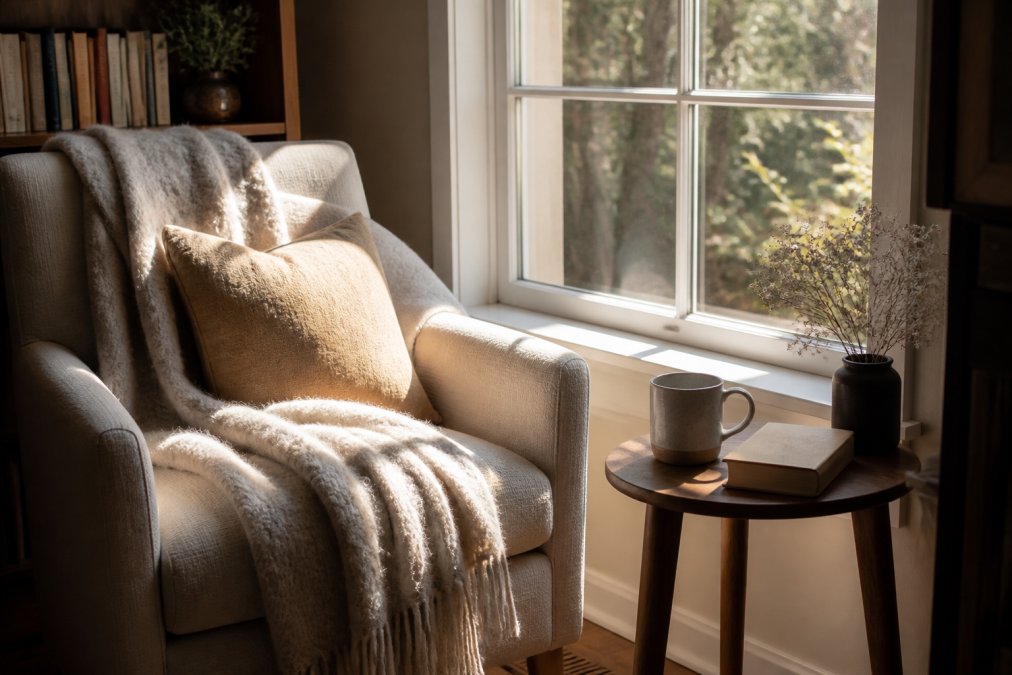
A reading sanctuary is a designated spot that signals to your brain that reading is about to happen. It does not require a spare room, just one chair, one light source, and a surface for a cup, but how you assemble those three things determines whether the spot works.
The Three-Point Setup
A reading spot works when it satisfies three conditions at once:
- A dedicated seat. Not the couch you also watch TV on, not the desk where you answer email. One chair, used mainly for reading.
- A light source at shoulder height. A floor lamp or wall sconce positioned so the light falls onto the page, not into your eyes. Overhead ceiling light flattens the room and creates glare on paper.
- A landing surface within arm's reach. A side table or stool wide enough for a mug, a bookmark, and a journal. If you have to stand up to set your tea down, you break the spell every few minutes.
Making It Work in a Small Space
You do not need a nook, you need a corner: the end of a sofa nearest a window, an armchair angled away from the television, or a stool at a kitchen counter when no one is cooking. The rule is subtraction, not addition, remove one competing activity rather than adding furniture.
If your home has no spare corner at all, a folding chair and a clip-on reading light stored in a closet can be assembled in ninety seconds and disassembled just as fast. The ritual of setting it up becomes part of the ritual of reading.
Light, Texture, and the Tactile Experience
The physical details matter more than most guides admit. A warm lamp, around 2700K to 3000K, the color of an incandescent bulb, reduces the harshness cool white LEDs create on paper (Color and Spectrum). A wool or cotton throw adds weight and warmth that anchors you in the chair, and a ceramic mug gives your hands something to do during the pauses.
This is where the tactile experience of print separates itself from a screen. Paper has weight, grain, and a smell, and turning a page marks progress while resting your eyes from a fixed focal distance. A journal beside the chair lets you capture a line that struck you, turning passive reading into reflection.
Sound and the Fourth Wall
Most guides ignore sound, but it is the fastest environmental lever you have. A closed door, foam earplugs, or a low-volume instrumental playlist reduce the startle response that yanks you out of a paragraph. The goal is not silence but predictability: a steady hum is easier to read through than intermittent noise, because your attention stops scanning for the next interruption.
What to Leave Out
The sanctuary is defined as much by what you exclude as by what you include. No phone on the side table, no laptop within reach, no unread mail in your line of sight. Every object should support reading or be neutral to it; anything that pulls your eyes away is a leak in the ritual.
Mindful Reading Habits: The Slow Reading Technique
Slow reading is a deliberate method of reading at a pace that allows comprehension, emotional response, and reflection rather than volume or speed. It has four moves and works with any book.
- Set an intention before you open the book. One sentence: why this story, why now.
- Read at speaking pace. If you could not read the sentence aloud comfortably, you are moving too fast.
- Pause at the end of each chapter. Ten seconds. Let the scene settle before you move on.
- Mark one passage. Underline it or copy it into a journal. One per session is plenty.
The payoff is mental clarity. When you slow the input, you stop skimming for plot and start noticing language, mood, and detail, the difference between consuming a story and living inside one.
Physical vs. Digital Reading: What Changes When You Slow Down
Print and screens are not interchangeable, and the difference shows up most in retention and immersion. Research on reading comprehension has repeatedly found that readers absorb narrative and argument better on paper, largely because a physical page offers spatial landmarks a scrolling screen does not (pubmed.ncbi.nlm.nih.gov).
Digital reading has real advantages: portability, adjustable type, instant access at night. If a screen gets you reading on a plane or in a waiting room, use it. But for the slow reading ritual itself, print removes the notification layer, every e-reader is one tap away from email.
A practical split works for most people:
| Format | Best For | Watch Out For |
|---|---|---|
| Evening ritual, deep immersion, retention | Not portable for travel | |
| E-reader | Travel, adjustable type, one-hand reading | Notifications and app switching |
| Audio | Commutes, chores, walks | Easy to drift without noticing |
Curating a Slow Bookshelf: Quality Over Quantity
Most slow-living guides tell you to own fewer, better books, but almost none explain how to decide which books those are. Here is a working method for building a shelf that reflects slow values instead of good intentions.
A slow bookshelf is small on purpose. It holds books you intend to reread, lend, or sit with, not books you bought to feel productive. If you would not clear an evening for it, it does not earn shelf space.
The Three-Question Filter
Before a book earns a permanent spot, run it through three questions:
- Would I reread this? Not "should I", would I. If the honest answer is no, the book is a loan, not a resident.
- Does it slow me down or speed me up? A thriller that keeps you up past midnight is not a slow-living book, and that is fine, it just belongs in a different category.
- Does it change how I see something? The books that stay leave a residue. A single line you still think about six months later is worth more shelf space than ten books you finished and forgot.
The Four Shelves
A slow bookshelf is easier to maintain when you stop thinking of it as one shelf and start thinking of it as four:
- The reread shelf. Five to fifteen books you return to every year or two. These are the spine of the collection.
- The slow-read shelf. Books that reward a chapter a week, essays, nature writing, philosophy, poetry. They are not meant to be finished quickly.
- The lending shelf. Books you loved once and are ready to pass on. Keeping them is hoarding; giving them away is the point.
- The incoming shelf. One small stack, capped at three or four titles, of books you have not yet read. When it grows past that, you stop buying until it shrinks.
Curating by Subtraction
The hardest part of curation is removal, and it is what actually changes the shelf. Once a season, pull three books you will never open again and pass them on, to a friend, a little free library, a used bookstore. What remains reflects who you are now, not who you meant to be in 2019.
A useful rule of thumb: if you cannot remember why you bought a book, you have your answer.
Choosing Fewer, Longer-Lasting Reads
Quiet, emotionally resonant novellas suit slow living especially well because they can be finished in a few sittings and revisited without a months-long commitment. A 150-page book you read three times over five years gives you more than a 600-page book you read once and shelve. Nova Basi publishes a collection built exactly for this: short, atmospheric stories set in places like Sicily and southern France, paired with journals and keepsakes that extend the reading into the rest of your day. A title like Timeless in Roussillon is designed to be read slowly in one or two evenings, then kept.

What a Slow Shelf Is Not
It is not a display shelf or a reading-list trophy case, and it is not organized by how impressive the spines look on a video call. A slow shelf is a working shelf, dog-eared, annotated, and slightly uneven, because the books on it have been used.
Common Mistakes That Break the Reading Ritual
The ritual usually fails for predictable reasons, each with a fix.
- Setting a page goal instead of a time goal. Pages create pressure; time creates a container. Read for 15 minutes, not 30 pages.
- Reading only on weekends. A weekly binge never becomes a habit; daily small sessions do.
- Buying books faster than you read them. The unread pile becomes a source of guilt, and guilt kills the desire to sit down.
- Treating reading as a task to finish. If you are racing to the last page, you are not reading slowly, you are commuting through a story.
- Reading where you work. Your brain has learned that chair means deadlines. Move the ritual somewhere else.
Conclusion: Carrying the Story Past the Last Page
The hardest part of slow living with books is not starting. It is keeping the feeling after the final page, when the real world rushes back in, the gap Nova Basi was built to close.
Nova Basi offers quiet, emotionally resonant novellas alongside curated journals and keepsakes, so the atmosphere of a story stays in your daily routine instead of fading by morning. The novellas are short enough to finish in an evening, and the accompanying rituals give you a reason to return to the same chair tomorrow. Explore Now and find the story that slows your week down.
Frequently Asked Questions
How can reading help you practice slow living?
Reading forces a single point of focus that most daily tasks never require. When you sit with a book for twenty uninterrupted minutes, your attention narrows to one page, one sentence, one image. That narrowing is the same mechanism behind meditation and deep work. Slow living with books works because the format itself resists speed: you cannot skim a paragraph and absorb its atmosphere at the same time. The practice builds mental clarity and presence through repetition rather than effort.
How do you create a reading ritual for mindfulness?
Pick one fixed cue, such as making tea or dimming a lamp, and repeat it every time you read. Keep the session short enough that you never dread it: fifteen to twenty minutes is enough. Put your phone in another room rather than face-down beside you. Read one section, then pause for a few breaths before continuing. The ritual matters more than the page count. Over a few weeks, the cue alone will start to settle your nervous system before you open the book.
Is reading 50 pages in 2 hours slow?
That pace works out to roughly 25 pages an hour, which is slower than average for most adult readers. Whether it counts as slow reading depends on what you are doing with the time. If you are rereading sentences, noticing imagery, and pausing between chapters, the pace reflects contemplation rather than difficulty. If you are struggling through dense text, it reflects the book. Slow reading is a choice about attention, not a speed threshold.
What are the best books to start a slow living journey?
Start with something short enough to finish in a few sittings, so the ritual has a natural end point. Quiet, atmospheric novellas work well because they reward pacing over plot momentum. Nova Basi's Earthstar Bright, set in the luminous landscapes of Southern France, runs $2.99 and is built for exactly this kind of reading. Timeless in Roussillon, also $2.99, centers on stillness and the beauty of being present, which makes it a natural first pick.
Building a reading practice that survives a demanding career is less about discipline than about design: a protected 15 minutes, one comfortable chair, and a book worth sitting with. Nova Basi makes that easier with novellas written for unhurried reading and keepsakes that carry the story into your everyday life. Explore the collection and start with a single quiet evening.